


When antidepressants have not provided sufficient relief, your psychiatrist may discuss other options for treatment-resistant depression, including transcranial magnetic stimulation (TMS) and ketamine treatment. Both are used to treat depression that has not responded adequately to previous treatment, but they work differently and involve different treatment processes.
This article explains how TMS and ketamine treatment work, how they differ in practice, and what to consider when comparing the two approaches. It is intended to support an informed discussion with a specialist, not replace medical advice. Suitability for either treatment depends on an individual psychiatric assessment.
What Is Treatment-Resistant Depression?
Treatment-resistant depression generally refers to depression that has not responded adequately to at least two antidepressants, each taken at an appropriate dose for an adequate duration. Some people continue to experience significant symptoms despite trying several treatments, making it important to explore other options.
TMS and ketamine treatment are among the approaches that may be considered when standard depression treatments have not provided sufficient improvement. Neither is typically a first-line option, and the most appropriate next step depends on your symptoms, treatment history and individual circumstances.
How Does TMS Work?
Transcranial magnetic stimulation (TMS) uses magnetic pulses to stimulate specific areas of the brain involved in mood regulation.
How it works
- Targeted stimulation: An electromagnetic coil is placed against the scalp to deliver magnetic pulses to a specific brain region, usually the left dorsolateral prefrontal cortex.
- Repeated sessions: Treatment involves repeated stimulation over several weeks to improve depressive symptoms.
- No medication required: TMS does not require medication or anaesthesia. You remain awake and seated throughout treatment.
What are the different types of TMS?
Two commonly used approaches are:
- Repetitive TMS (rTMS): Delivers repeated magnetic pulses to targeted areas of the brain.
- Intermittent theta-burst stimulation (iTBS): Uses a different pattern of magnetic pulses to deliver treatment in a much shorter session.
Most people can return to their usual activities after a TMS session.
How Does Ketamine Treatment Work?
At Save Minds, ketamine is administered through an intravenous (IV) infusion in a monitored clinical setting. Unlike TMS, which uses magnetic pulses to stimulate targeted brain regions, ketamine works through chemical signalling in the brain.
How it works
- Different brain mechanism: Ketamine acts on the brain’s glutamate system, which plays an important role in communication between neurons. Its effects on this system are thought to contribute to its antidepressant effects.
- Different from conventional antidepressants: Many standard antidepressants primarily affect serotonin or noradrenaline signalling, whereas ketamine acts through a different mechanism.
- Medical monitoring: Ketamine can affect the body during treatment. Healthcare professionals monitor vital signs, including heart rate, blood pressure and oxygen levels, and observe you after each infusion.
Is ketamine treatment licensed for depression in the UK?
Intravenous (IV) ketamine is licensed for use as an anaesthetic in the UK, but it is not specifically licensed to treat depression. Prescribing it for depression is therefore considered off-label use. This means a clinician may prescribe the medicine for depression based on their clinical judgement, taking into account the patient’s circumstances, the potential risks and benefits, and the available clinical research.
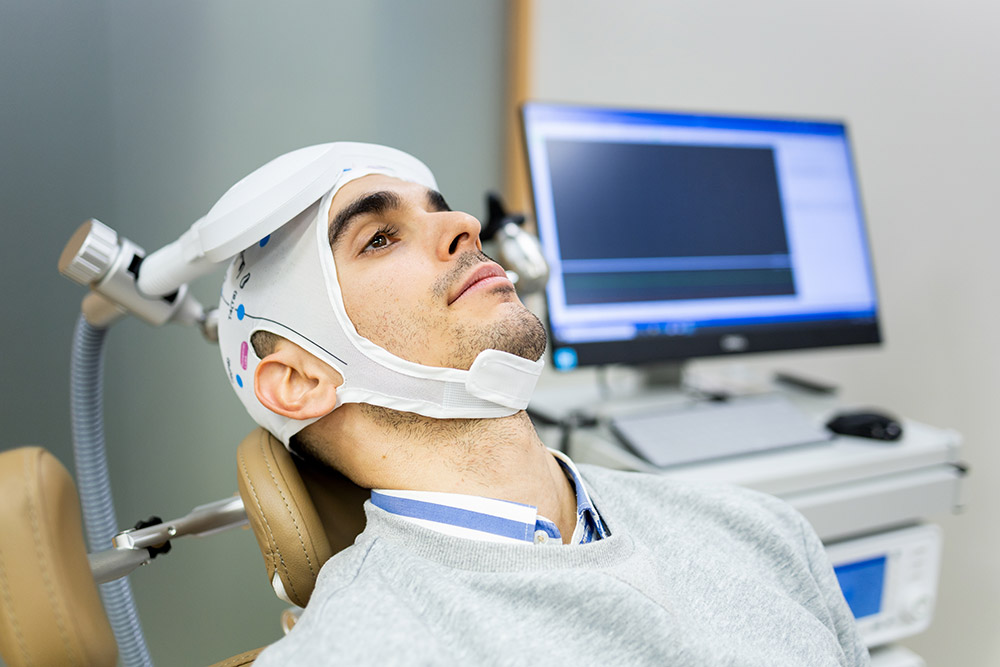
TMS and ketamine treatment differ in how they work, who delivers them and what a session involves. Suitability for either depends on a psychiatric assessment.
TMS vs Ketamine Treatment: The Key Differences
Although both treatments may be considered for treatment-resistant depression, they differ in how they work, how sessions are delivered and what patients can expect.
What kind of treatment is it?
TMS is a device-based treatment that uses magnetic pulses to stimulate targeted brain regions without introducing medication into the body. Ketamine treatment is a pharmacological intervention: the medicine acts on the brain and can also affect other parts of the body. This is why medical monitoring is an important part of ketamine treatment.
Who delivers the treatment?
TMS is generally delivered by a trained healthcare professional, with clinical oversight from a psychiatrist or other appropriately qualified clinician, depending on the service. At Save Minds, ketamine treatment is administered by a consultant in anaesthesia and intensive care medicine, with a consultant psychiatrist responsible for assessment and treatment planning.
What does a session involve?
During TMS, you remain awake while the magnetic pulses are delivered. You can usually return to your usual activities shortly afterwards. With ketamine treatment, you receive an infusion in a monitored clinical setting. The medicine may cause temporary changes in perception, dissociation or other effects, which the clinical team monitors throughout the session. You will need to follow the clinic’s advice about recovery and transport, including not driving after ketamine treatment.
How many sessions are required?
TMS usually involves frequent sessions over several weeks. The schedule for ketamine treatment varies according to the provider and individual treatment plan. At Save Minds, treatment begins with an initial course of twice-weekly sessions for a minimum of five weeks, followed by tapering as the consultant sees fit, based on the patient’s clinical progress.
How is progress measured?
Both treatments require clinical review to assess whether symptoms are improving and whether to continue treatment. Validated clinical rating scales can help measure changes over time. At Save Minds, we use daily check-ins through the clinic’s app and clinical rating scales to monitor progress throughout the programme. The consultant reviews this information alongside your overall response when deciding whether the treatment plan needs to change.
How to Choose Between TMS and Ketamine Treatment
There isn’t one universal treatment that suits everyone; the right option depends on your symptoms, treatment history, physical health and personal circumstances. A psychiatric assessment can help determine which approach may suit you.
When comparing TMS and ketamine treatment, your psychiatrist will consider:
- Your treatment history: Which treatments you have tried, how well they worked and whether you experienced side effects.
- Your symptoms: The severity of your depression and how it affects your daily life.
- Your medical history: Any health conditions or other factors that could affect your suitability for either treatment.
- Practical considerations: How often you need to attend sessions, how long treatment takes and the travel involved.
These factors help your psychiatrist determine which options may be appropriate and explain the reasoning behind their recommendations.
Some people may receive TMS and ketamine treatment at different stages of their care, depending on their needs and clinical advice. Choosing one does not automatically rule out the other. If a clinic offers only one option, ask whether the alternative might also be worth discussing with your treating psychiatrist.
Ketamine Treatment at Save Minds
Save Minds is a private, consultant-led clinic in St John’s Wood, London, registered with the Care Quality Commission (CQC). The clinic provides intravenous ketamine treatment for adults with treatment-resistant depression and other mental health conditions, including anxiety, PTSD, OCD and severe suicidal ideation.
Start Your Assessment Process for Ketamine Treatment
If you are exploring ketamine treatment after a limited response to previous mental health care, you can contact Save Minds to begin the assessment process. You can also take our short eligibility check to see if we’re the right fit.
The team can guide you through any referral requirements, arrange a psychiatric suitability assessment and help you understand whether this approach may be appropriate for your circumstances. Every enquiry is handled confidentially, and there is no obligation to proceed.
📞 +44 20 7722 0865
✉️ info@saveminds.co.uk
FAQs
How does ketamine treatment differ from TMS?
Ketamine treatment involves administering a medicine intravenously, while transcranial magnetic stimulation (TMS) uses magnetic pulses to stimulate specific areas of the brain associated with mood regulation. Ketamine acts on the brain’s glutamate system and requires clinical monitoring during and after treatment, whereas TMS is generally performed while the patient remains awake without sedation. In the UK, ketamine is prescribed off-label for depression, while repetitive TMS is supported by guidance from the National Institute for Health and Care Excellence (NICE).
Which works faster, TMS or ketamine?
The time it takes to notice improvement varies by individual and depends on the treatment approach. Some people receiving ketamine may experience changes in depressive symptoms within days, although the effects may be temporary and further treatment may be needed. With TMS, improvement may become noticeable after two to four weeks of regular sessions, but neither treatment guarantees a response.
How many sessions does each treatment involve?
A typical course of repetitive TMS involves 20–30 sessions over four to six weeks, usually delivered five days a week. Standard sessions generally last around 20–40 minutes, while some intermittent theta burst stimulation (iTBS) protocols take approximately three minutes. At Save Minds, the initial ketamine treatment course comprises at least 10 treatments over five weeks, followed by a tapering phase based on clinical assessment and response. Most patients complete 15–20 sessions over four to six months.
What are the side effects of ketamine and TMS?
TMS may cause temporary headaches or discomfort at the stimulation site, while seizures are a rare but recognised risk. Ketamine can cause short-term effects such as dissociation, altered perception, dizziness, nausea and a temporary increase in blood pressure. Appropriate screening, monitoring and post-treatment observation help clinicians manage potential risks, and your treating clinician should explain the possible side effects before treatment begins.
Is TMS available on the NHS in the UK?
TMS is available through some NHS services, although access varies by location and availability may be limited. Eligibility and waiting times depend on local service arrangements and individual clinical circumstances. Intravenous ketamine treatment for depression is also available through limited specialist NHS provision, while private clinics offer additional treatment options.
Can you have TMS and ketamine treatment?
Some people may be considered for both TMS and ketamine treatment at different stages of their care. Whether this is appropriate, and when each treatment should be given, depends on individual clinical circumstances, previous treatment response and the advice of the treating psychiatrist. If you have recently received either treatment, tell your clinician during your assessment so they can consider it in your care plan.
What do TMS and ketamine cost privately in the UK?
The cost of private TMS varies depending on the provider, treatment protocol and number of sessions included, so it is important to check whether a quoted price covers a full course or individual sessions. Some private insurers may consider TMS cover on a case-by-case basis. At Save Minds, the listed fees are £450 for the psychiatric consultation, £990 for the first ketamine treatment session (including an ECG and blood tests) and £595 for each subsequent session; further details are available on the Save Minds pricing page.
Who is a suitable candidate for each treatment?
TMS and ketamine treatment may be considered for adults whose depression has not responded adequately to previous treatment, but suitability must be assessed individually. For TMS, clinicians consider factors such as metal implants or devices near the head and a history of seizures or certain mental health conditions. For ketamine, cardiovascular health, blood pressure, mental health history and substance use are important considerations; a psychiatrist will also assess other factors, including pregnancy, when determining whether treatment is appropriate.